
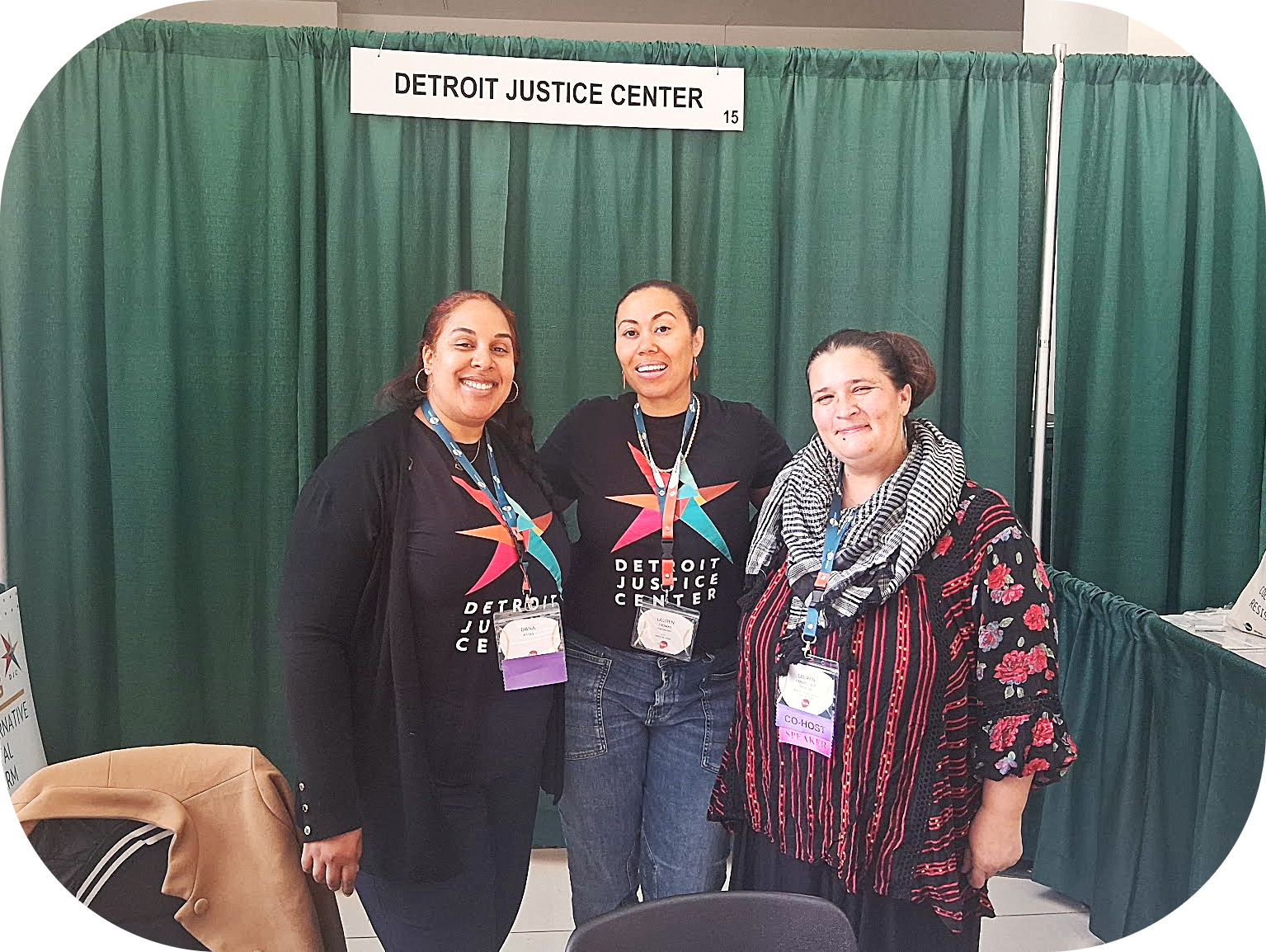

In November 2025, we co-sponsored the Reform Conference, held by the Drug Pollicy Alliance (DPA), in Detroit. Now that we’re a few months removed from the event, we asked our Divest/Invest Program Manager, Sheba Rogers, and our Paralegal, Safiya Webster, to reflect on their experiences of the conference and what takeaways they’re bringing into our work in 2026.
What are your reflections from the DPA Reform Conference, and how did the conference impact you?
Safiya Webster: The DPA Reform Conference impacted me by challenging the notion of justice in the context of our criminal justice system. The purported notions of justice within our criminal legal system also serve as a barrier to drug policy reform and the harm reduction framework. Crisis response leaders, advocates, and harm reductionists engaged in a conversation discussing that there can’t be justice in a system that was formed in slave-catching. Further, there cannot be justice within law, when we’re enforcing racist and harmful laws. These thought-provoking ideas direct us back to the root cause of the current injustice of drug policy as it exists now. Our policies and our criminal legal system is rooted in white supremacy and racism. Drug policy is not absent of race, and injustice is generally not absent of white supremacy. Furthermore, our criminal justice system itself and its conception of justice centering retribution and retaliation will always exist as a barrier to drug policy reform and the harm reduction framework, until conceptions humanity and wholeness are prioritized and centralized.
Sheba Rogers: This was the second DPA Conference that I’ve attended – I was overjoyed for it to be held in Detroit and to be able to support aspects of planning as DJC was one of the co-host partners for the conference. I enjoyed the many plenary discussions, breakout group sessions, and overall reconnecting with partners both new and old. It was inspiring to dive into historical and current day barriers and solutions to drug policy and mental health challenges, including the impact of the crack epidemic on Black families not just in Detroit, but across the country. It was rich with information as simultaneous conversations were taking place – racial disparities in treatment and policy implementation; economic injustices that fuel drug policy outcomes; medical industry failures and advancements; the impact of forced treatment, and so many other relevant topics that impact our ability to influence sustainable change. This was a space where we were able to center the necessity of community-based responses to care, harm reduction, and systemic changes needed to ensure people are cared for, instead of punished, on their journey toward treatment and healing. The impact of the conference for me was the culminating feeling of boldness and inspiration that comes from being in space with like-minded, values-aligned comrades leading on-the-ground work to save lives, repair harm, and demand justice.
What are 1-2 key takeaways that you left the conference with?
Sheba Rogers: For more than three days we gathered to discuss barriers to drug policy reform, to uplift promising practices, and to share learnings and successes from local and national initiatives. One key takeaway is how vast and interwoven the barriers are to drug policy reform, and the many factors that play a role in addressing the underlying harms of drugs in our communities. Reforming and abolishing harmful drug policy calls for us to also address the conditions that perpetuate drug reliance in the first place – often a lack of economic stability; racial injustice in policing, incarceration, and health care; housing instability; negative views and misunderstanding about the need for harm reduction; and a lack of funding for community-based services to meet the needs of the community, to name a few. Local and state governments have significantly divested in health and mental health care, housing, education, employment, community safety and healthy living, while overspending on jails, prisons, policing and other punitive programs as a means to address the drug policy crisis. DJC initiatives such as our mental health partner roundtable, Metro Detroit Restorative Justice Network, and economic equity initiatives work to advance community-based, non-carceral, trauma-informed, restorative solutions to the conditions caused by systemic injustice. Being together with comrades both nationally and internationally fueled my commitment to solidarity – this is work that we must do together, with an aligned mission to not only reform, but to abolish the systems and policies that do not and have not served us for decades.
Safiya Webster: Some of my key takeaways from the conference include imperative notions for narrative shifting in drug policy reform, the current solutions to the criminalization of substance-abuse and mental health crises, and reflections on the notions of justice within our criminal legal system, including:
- Centering the notion that instead of drug-use being solely a willful activity, that people are struggling with drug-use.
- An emphasis that retribution and punishment of people who use drugs does not offer a path to healing.
- Recognizing that what protects stories of grief from being weaponized, is not speaking palatably about the harms of drug-use and its systems of care and criminalization.
Looking ahead, what policy solution or recommendation would you offer as a call-to-action?
Safiya Webster: Concerning solutions to the criminalization of substance-abuse and mental health crises, advocates at the conference argued that community-based public safety responses are a current solution to diverting folks from incarceration. Further, there needs to be an immediate response to folks being picked up on mental health and drug-related charges that involve community care instead of police aggression. Presenters also stated that people with actual lived experiences need to be involved in policy-making when legislators are writing drug policies. The harm reduction advocates also emphasized the importance of advancing the fight for the implementation side of policy reforms, so that solutions are reaching their intended consequences. Lastly, a financial investment in street-based outreach programs was another solution suggested in addressing the criminalization of mental health and drug-use. These solutions were supported by successful examples of reform, such as the Community Commission for Public Safety and Accountability formed in 2021 in Chicago, which provides community oversight of police and a space to produce community-based public safety reforms, in addition to Canadian public health investment in harm reduction programs that have proved success in limiting the risks of drug use. These points are valuable in approaching policy reform, as they center the humanization of people who use drugs or those impacted by the use of drugs, considering that the population is heavily stigmatized and dehumanized through dominant narratives of immorality and delinquency.
Sheba Rogers: The deep-dive topics and conversations held throughout the conference felt like a continuation of the joint community forum on drug policy that DJC and DPA held in Detroit this past October, and a continuation of the mental health partner convening hosted by DJC and partners in December of 2024. The people attending the conferences and forums are often the ones who have the lived experience; who know the issues personally; who have been criminalized for drug use or paraphernalia; who risk their own lives to help save the lives of their neighbor experiencing overdose; and who are the product of divested and failed systems. We gather and share learnings across fields and industries, strengthening our capacity and reach to make impactful change in our communities. However, these conversations must expand outside of drug policy conferences and convenings.
Helping to change the narrative is the radical call-to-action we must all accept, otherwise we perpetuate the myths that keep harmful drug policies in place. If we are not addressing the root causes of harm, violence, and drugs, and its impact on the well-being of children, families and communities, we by default reinforce mass incarceration and its devastating consequences. It has been well documented across research studies that people experiencing mental health and substance use disorder are often criminalized in the absence of trauma-informed crisis response and treatment options, making jails and prisons de facto mental health care providers. Vera Institute reports that forty percent of people in state prison qualified as experiencing substance use disorder within the 12 months leading up to their admittance. This is merely one example of many that uncovers the disparity and the dysfunction of policies that portray to help but instead criminalize people experiencing mental health, substance use, housing and other life-essential needs. Shifting how we speak, advocate and create policy is the narrative-change work we all can take part in – emphasizing community-based care over incarceration; culturally relevant support over stigma; love and dignity over labels of addiction; harm reduction over criminalization; restorative practice over punishment.