
Every year since 2020, the Detroit Justice Center has been asking Wayne County artists to submit project proposals that grapple with the question:
“What does a world without police and incarceration look like?”
What would it feel like to exist in a world without the police and incarceration, without jails, prisons, and detention centers? What would be the textures and sensations of that world? What patterns of interactions and relationships would transform for the communities that would be born as we realize these demands of structural change?
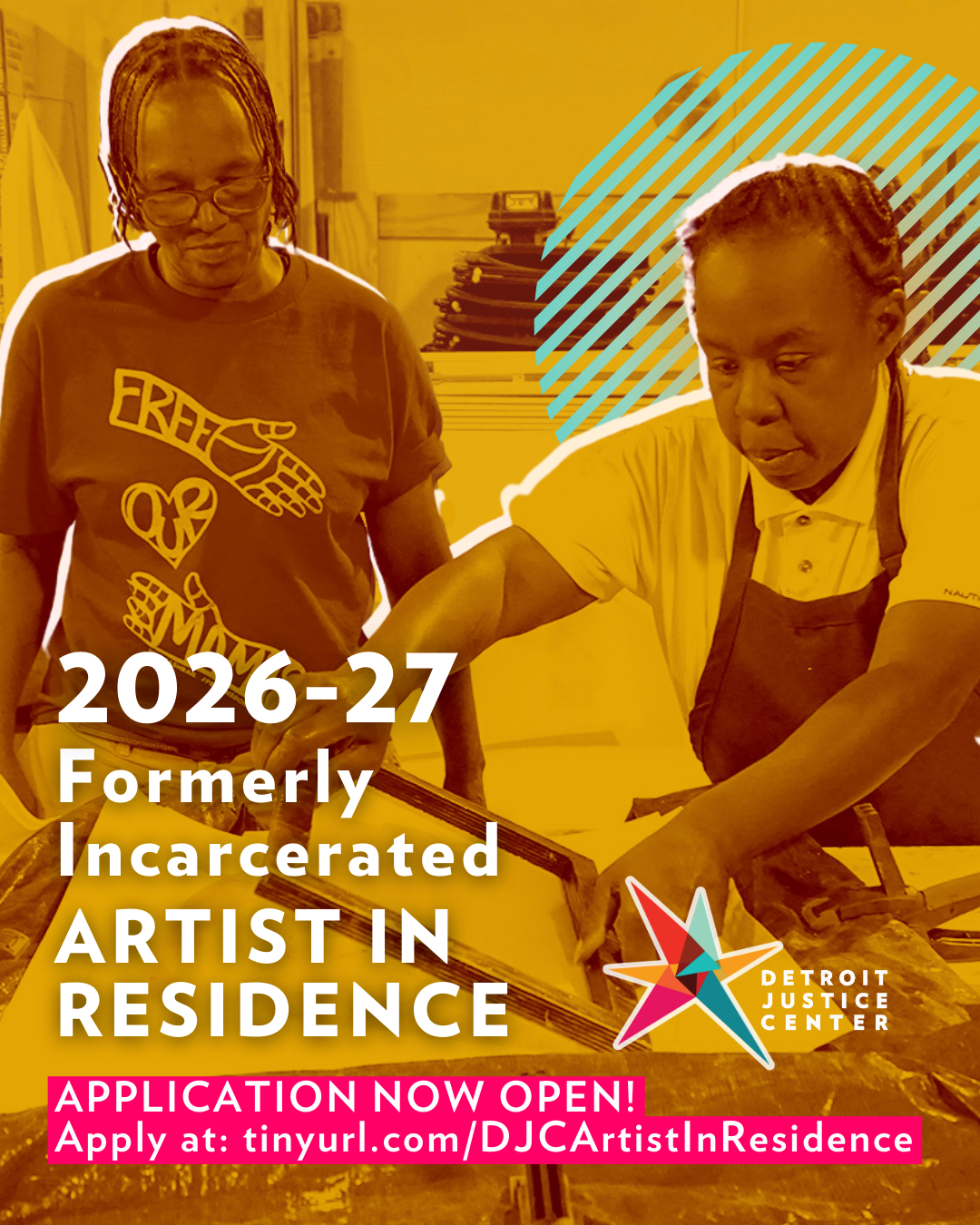
Inspired by Detroit’s long history of arts and activism, we look to artists to dream of new worlds and engage our community in visioning safety without punishment. We are excited to announce that we are expanding our artist residency! Starting in 2026, we will be offering two different residencies open to artists living in the state of Michigan. The first is specifically for formerly incarcerated artists in Michigan, and another that is open to all artists. Applications for the formerly incarcerated artist residency open January 2nd, 2026, and will close February 15th, 2026. Applications for the second residency will open in July 2026.
Applicants may work in any artistic medium and may submit up to five work samples as part of the application process. We ask that applicants who use time-based mediums (such as dance, music, and video) limit their work samples to no more than 20 minutes total. Anyone submitting written work is asked to limit their work sample to no more than 15 pages total.
The formerly incarcerated artist whose project is chosen by our panelists will receive $20,000 and will have until March 2027 to create and execute the proposed project. Applications close on 2/15/2026.
We strongly encourage people of color, women, LGBTQ people, people with disabilities, and individuals with past involvement in the criminal punishment system or who have loved ones currently or formerly in the criminal punishment system to apply.
DJC ARTIST IN RESIDENCE PROGRAM – FAQ
What is the DJC Artist in Residence Program?
It’s a year-long opportunity for two Michigan-based artists to create work that pushes our understanding of what safety, freedom, and community care could look like beyond policing and incarceration. The residency includes funding, connection with DJC staff, community engagement opportunities, and support for the artist’s creative process.
One of the two selected artists will be a person who has experienced incarceration.
Who can apply?
Artists must:
● Live in Michigan (any county, including the UP)
● Be 18 or older
● Be able to participate in virtual or in-person meetings with DJC
● Work in any artistic medium
You do not need a college degree, an arts resume, or exhibition history.
Formerly incarcerated artists are strongly encouraged to apply.
Do I have to identify as an abolitionist?
No. You do not need to use that language, and you don’t need to be part of any movement or organization.
We’re interested in artists who are imagining, dreaming toward, or wrestling with what safety and community could look like without cages, punishment, or policing.
If your work engages that terrain, you’re in the right place.
What kind of art can I submit?
Any medium is welcome: writing, visual art, performance, installation, music, film, textiles, digital, craft, or mixed forms.
You can submit:
● Written proposals
● Audio recordings
● Video explanations
● Low-resolution images
● Phone documentation
We believe in accessibility. You do not need professional equipment.
Do I need to have a complete project idea before applying?
No. You can come in with:
● A fully formed proposal
● A starting point
● A question
● A direction you want to explore
Your application should show us what you care about and how your artistic voice holds the future you’re imagining.
What is the main question I need to respond to?
We’re asking artists to grapple with: “What does a world without police and incarceration look and feel like?”
Your proposal doesn’t need to answer this perfectly. We’re more interested in your thinking, your voice, your angle, and the possibilities you’re reaching toward.
Are people currently on parole or probation allowed to apply?
Yes — as long as your supervision conditions allow you to participate in residency activities. If you’re unsure, you can reach out to us privately to talk through what participation might look like.
Can I apply if I don’t have stable housing or transportation right now?
Yes.
We are building this residency with real life in mind. Selected artists will receive:
● Transportation support
● A housing plan or stipend
● Meal support
● Additional basic-needs assistance
If applying feels overwhelming, we offer help.
Is the application accessible for people with limited internet or tech experience?
Yes. We designed it that way.
You can apply from a phone. You can upload audio or video instead of writing. We provide:
● A video walkthrough of the application
● A plain-language explanation of the scoring rubric
● Optional office hours for application help
Partners across Michigan can also support applicants who need a device or internet access.
Can I get help with my application?
Yes. DJC will offer:
● Virtual office hours
● Email support
● Phone support
● Guidance videos
● A plain-language FAQ inside the application itself
We want artists to feel confident, not confused.
How many artists will be selected?
Two artists each year. One spot is reserved for a formerly incarcerated artist.
What do residents receive?
Each artist receives:
● Residency stipend/funding
● Support from DJC staff
● Opportunities to engage community members
● A platform to share work
● Resources to stabilize your participation (housing, transit, meals, accessibility needs)
Exact amounts and logistics will be shared on the application page.
Do residents have to produce a final artwork?
We expect a body of work, project, or public engagement experience — but the form is up to you.
Your process matters. Your evolution matters. This isn’t an assembly line.
How are applications reviewed?
A panel of 5 artists and justice-impacted leaders (including formerly incarcerated people) will score each application using a plain-language rubric.
Panelists look for:
● Clarity of your artistic vision
● Connection to the residency question
● Thoughtfulness of your proposal
● Feasibility within the residency timeline
● Creative voice, imagination, and perspective
This is not a competition around polish or credentials.
Who are the panelists? (click to visit panelists’ websites)
Tylonn Sawyer, Halima Cassells, Reginald Dwayne Betts, Asia Johnson, and Johnny Van Patten
Will my application or personal information be kept private?
Yes. Your information is shared only with DJC staff and panelists. We do not publish personal histories or anything you don’t want shared publicly.
If I’ve never applied to a residency before, is this for me?
Absolutely. This residency was built with you in mind — especially artists who haven’t always been welcomed or supported in traditional arts spaces.
Can I apply if I’ve been rejected before?
Yes. Every cycle is different, and you’re encouraged to try again.
When are applications due?
February 15, 2026
How do I apply?
Submit your materials through Slideroom at:
https://djc.slideroom.com/#/permalink/program/87314/AbS07fYVlk
Are there any other ways to get assistance with the application?
Yes! There will be a Q & A on January 21, 2026 at 6:30-7:30PM
And virtual office hours:
Every Mon 6 pm- 7 pm EST from Jan. 12 to Feb. 9
(except for MLK Day: Jan. 19)
Every Weds 12-1 pm EST between Jan. 7 and Feb. 11
Who can I contact with questions?
Email: media@detroitjustice.org We will respond as quickly as possible.